
Air Duct Cleaning in Chicago
We clean duct systems the way the industry standard says it should be done — the whole system put under negative pressure, every branch agitated, the debris captured in a HEPA machine instead of pushed into your rooms. Homes are $125 off with unlimited vents. Restaurants, groceries, offices and warehouses get a free on-site assessment and a written scope before anyone quotes a number.
First, the honest answer: not every house needs this
The EPA’s position is that duct cleaning “has never been shown to actually prevent health problems,” and that a light layer of household dust in a duct is not a hazard. It recommends cleaning when one of three things is true: visible mould growth inside the ducts or on system components, ducts infested with vermin — rodents or insects, ducts clogged with so much dust and debris that particles are actually being released into the rooms.
That is the standard our technician uses when he looks at your system. If your ducts are simply dusty and your system is running fine, we will tell you so and you will not be charged for a visit that talks you out of the job. Where it does pay off — after a renovation, after a rodent problem, on a house that has never been done, before a new furnace goes in — it pays off properly.
How we actually clean a duct system
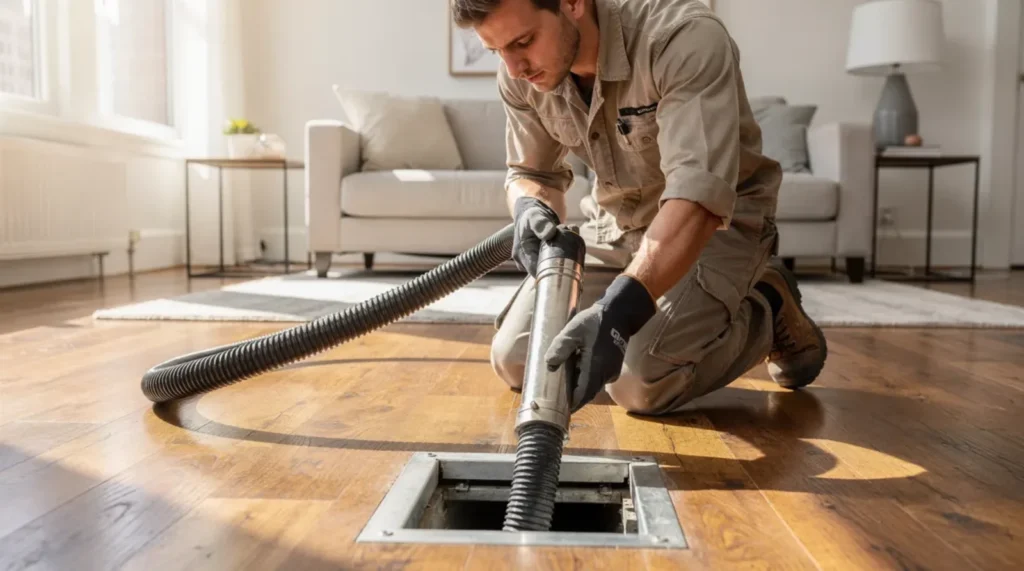
“Source removal” is the method the industry standard is built around: put the system under negative pressure, physically dislodge what is stuck to the duct wall, and capture it in the machine. Anything less — a shop vac at the register, a quick brush at the boot — just relocates dust.
- Inspect first. Camera down the trunk and branches, a look at the blower, coil and drain pan, and photos of anything that matters. You see what we see before work starts.
- Seal and contain. Every supply and return register is sealed so the system can hold vacuum, and walkways get drop cloths.
- Negative pressure on the trunk. A collection machine is connected to the main duct and runs the whole system under vacuum for the entire job, filtered at HEPA — 99.97% of particles down to 0.3 micron — so nothing that comes loose ends up in the house.
- Agitate every branch. Rotary brushes and compressed-air whips work each run back toward the vacuum. This is the step cheap jobs skip, and it is the step that actually removes anything.
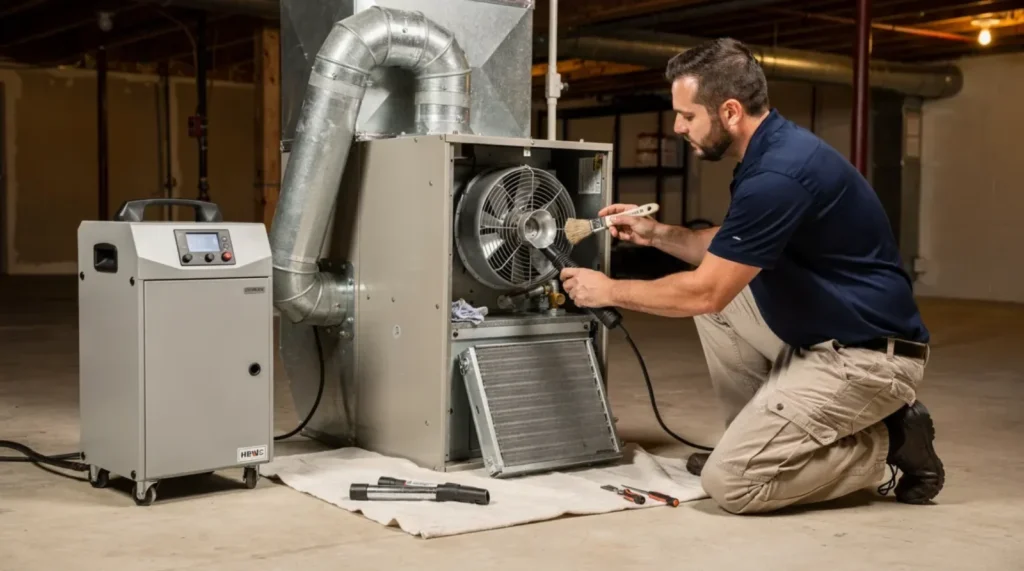
- Clean the parts that foul first. Blower wheel, evaporator coil, condensate pan, return drops, boots, registers and grilles. A caked blower wheel costs you more airflow than a dusty duct ever will.
- Verify and show you. Post-clean inspection with the camera, after photos next to the before ones, filter replaced, system restarted and airflow checked.
Homes: $125 off, unlimited vents
One price for the house, however many vents it has. A Chicago bungalow with nine supplies and a four-bedroom in Norwood Park with twenty-two are the same job to us — we are not counting registers on your ceiling to build up a bill.
Whole-home air duct cleaning — unlimited ventsOne flat price for the whole system. Nine vents or twenty-two, it is the same job and the same number.
Everything below is in the price — not an add-on
- Every supply and return run in the house
- Trunk lines and the plenum, not just the branches
- Blower wheel cleaned — where airflow is actually lost
- Evaporator coil and drain pan
- Registers, grilles and boots pulled and washed
- One standard 1″ filter, fitted before we leave
- Camera inspection before and after, with photos
- Full containment — sealed registers, drop cloths, HEPA capture
What a typical house looks like
| What | Detail |
|---|---|
| Time on site | 3 to 5 hours for most homes; a large or heavily fouled system can run longer |
| Included | All supply and return runs, trunks, plenum, blower wheel, evaporator coil, drain pan, registers and grilles, one standard 1″ filter |
| Add-ons | Dryer vent, humidifier service, UV or media filter cabinet, sanitizing only where there is a documented mould problem |
| What it normally costs in Chicago | Roughly $260–$390 for a whole home, or about $25–$50 a vent, according to published Chicago market data. Our flat price with the $125 off lands in that range — we publish it so you can compare like for like |
When it is genuinely worth doing on a Chicago house
- After a renovation. Drywall dust and sawdust get everywhere, and the return side pulls it straight into the furnace.
- After rodents or birds. Common in two-flats and older frame houses with open returns in the joist bays.
- A house that has never been done. A lot of our North Side work is on gravity-furnace-era ductwork converted to forced air, with runs that have never been opened.
- Before a new furnace or humidifier. New equipment pulling thirty years of debris into a clean heat exchanger is a bad first week. See furnace installation and indoor air quality.
- After water damage. Wet fibreglass duct liner does not dry out well — that is a replacement conversation, and we will say so.
Commercial: restaurants, groceries, offices, schools, warehouses
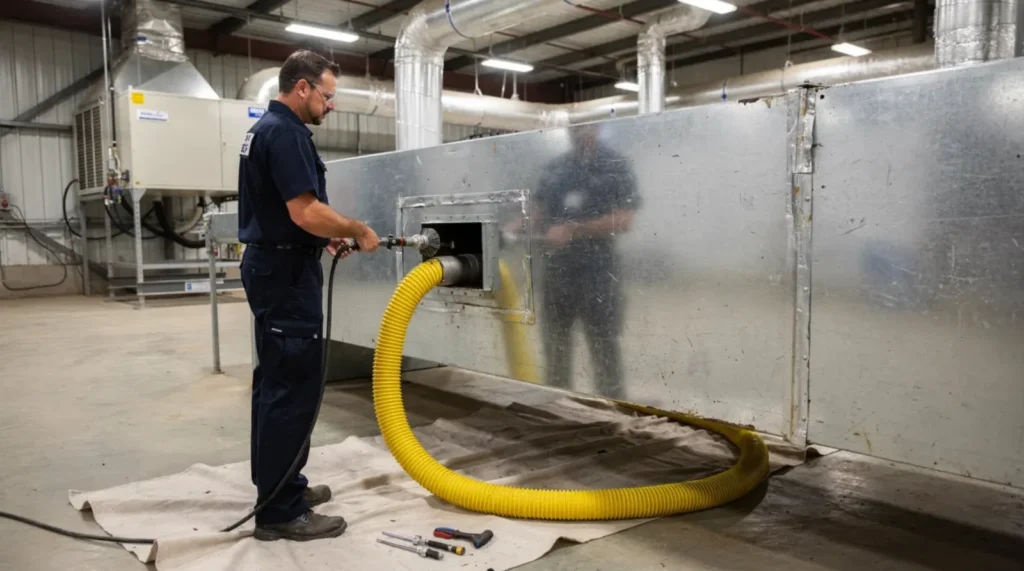
Commercial systems are a different animal: rooftop units, long rectangular trunks above a hard ceiling, VAV boxes, make-up air, and a building full of people who need the place open tomorrow. We have been doing commercial mechanical work in Chicago since 1987 — the same crews that service rooftop units and refrigeration handle the duct work.
- Night, weekend and holiday work so your floor stays open
- Access panels cut and fitted properly where the system has none
- Before-and-after documentation per zone for your maintenance file
- Coils, drain pans, fans and dampers, not just the duct
- Free on-site assessment and a written scope before any number is quoted
How often a commercial system should be looked at
The industry reference points are the ACR standard for assessment and cleaning and ANSI/ASHRAE/ACCA Standard 180, which sets minimum inspection and maintenance practice for commercial building HVAC. The inspection intervals the duct-cleaning industry works to look like this:
| Building type | Air-handling unit | Supply duct | Return & exhaust duct |
|---|---|---|---|
| Commercial | Every year | Every year | Every year |
| Healthcare | Every year | Every year | Every year |
| Residential | Every year | Every 2 years | Every 2 years |
Inspection is not the same as cleaning. The point of looking every year is that you clean when the system needs it, not on a calendar someone sold you.
Kitchen exhaust is a separate job
Grease hoods, ducts and fans are governed by fire code and cleaned to a different standard than supply air — that work lives on our kitchen exhaust hood page. If you need both, one visit, one invoice, one crew. Commercial buildings on a maintenance agreement get duct assessment folded into the scheduled visits.
Dryer vents
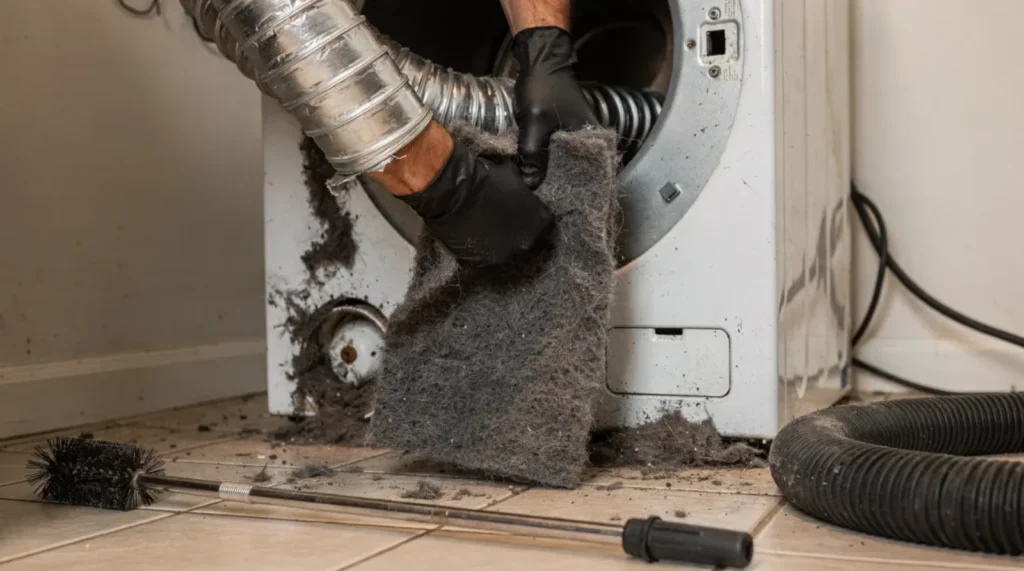
Worth doing on its own schedule, and the one duct in the building with a real fire record behind it. The U.S. Fire Administration counts about 2,900 clothes dryer fires in residential buildings a year, causing roughly 5 deaths, 100 injuries and $35 million in property loss — and the leading contributing factor, at 34% of ignitions, is failure to clean. January is the worst month.
Signs yours needs it: clothes taking two cycles to dry, the laundry room hot and humid during a cycle, a burning smell, lint visible around the outside flap, or a vent hood that never opens.
We clean the full run from the dryer to the exterior termination with a rotary brush and vacuum, check the flap, and reconnect the dryer properly — long flexible-foil runs crushed behind the appliance are the most common thing we find in Chicago condos.
What it costs when a system is left too long
Not scare numbers — these are the repairs a restricted, fouled system actually leads to, with the prices they carry. Every one of the first three is a part we clean as part of the job rather than sell you separately.
Blower motor replacement
Dirt build-up from skipped maintenance is a common cause of blower wheel failure, and a caked wheel makes the motor work against itself. A PSC motor runs $500–$1,400; a variable-speed ECM $800–$2,300.Source: HomeGuide, 2026 national cost data
Evaporator coil replacement
Restricted airflow across a coil is what ices it up, and a coil that keeps freezing does not have a long life. Replacement runs $1,000–$2,500 under warranty and $2,500–$4,500+ once the warranty is gone.Source: HomeGuide, 2026 national cost data
The dryer vent
Around 2,900 clothes dryer fires in residential buildings every year, roughly $35 million in property loss — and failure to clean is the leading contributing factor at 34% of ignitions. This is the one duct with a real fire record behind it.Source: U.S. Fire Administration
Your manufacturer warranty
Most equipment warranties require documented annual professional maintenance. No service records, no claim — which means the coil above becomes the $4,500 version rather than the $1,500 one. Keep the paperwork; we leave it with you.Check your own warranty terms — they vary by brand
And the part most duct-cleaning ads get wrong: you will read that dirty ducts add 30% to your energy bill. Lawrence Berkeley National Laboratory measured it and found the reduced airflow from coil fouling causes typical efficiency and capacity losses of under 5% — though it can be far worse on a marginal system or in extreme conditions. So we are not going to tell you this pays for itself in utility savings. It pays for itself by not turning into the repairs above.
What we will not do
No fogging your ducts with chemicals
The EPA notes that no products are registered as biocides for use inside fibreglass duct board or fibreglass-lined duct, and that the research on applying them is thin. We clean by removing the contaminant, not by spraying something on top of it. Where there is documented mould on a hard surface, we treat it properly — and where the liner is contaminated, we tell you it needs replacing.
No sealants painted over the problem
The EPA does not recommend routinely using sealants to encapsulate contaminants in any type of duct. Neither do we.
No price that changes once we are inside
The quote you get is the price for the house. No per-vent surcharge discovered at the door, no “deep clean” tier invented in your basement.
No selling you a job you do not need
If the system is clean, you get told it is clean. We would rather have the furnace tune-up and the next twenty years of your business.
How to compare any duct cleaning quote in Chicago
Use this on us and on whoever else you are calling. These are the questions the industry’s own commercial checklist tells building owners to ask, and they work just as well for a house.
- Is the price for the whole system, unlimited vents? A headline price with a per-vent charge underneath it is the oldest trick in this trade.
- Is the system put under negative pressure for the whole job? Ask what machine, and where it connects.
- What is the filtration on the collection equipment? HEPA, 99.97% at 0.3 micron, is the standard. Anything exhausting indoors without it is moving your dust around.
- Is every branch mechanically agitated? Brushes or air whips in each run — not just suction at the register.
- Are the blower, coil and drain pan included? This is where the restriction actually is.
- Do you get before-and-after photos? If a company will not show you inside your own duct, ask why.
- Is the company insured, and will you get a written scope first? For commercial, also ask who is signing off on the work plan.
- What happens if they find mould or vermin? A straight answer is a good sign. “We will sanitize it” is not an answer.
Air Duct Cleaning — Frequently Asked Questions
How often should air ducts be cleaned?
Is “unlimited vents” really unlimited?
Does duct cleaning lower my heating bill?
Can duct cleaning help with allergies?
Will it make a mess in my house?
How long does it take?
Do you clean dryer vents too?
Do you do commercial kitchen exhaust hoods?
Do I need to be home for the whole job?
What if you find something wrong with my furnace while you are in there?
Get your ducts looked at by someone who will tell you the truth
$125 off whole-home cleaning with unlimited vents. Free on-site assessment and written scope for commercial buildings. Family-owned in Chicago since 1987.